







The best FullStory alternatives & competitors, compared


Contents
FullStory made its name as a digital experience intelligence platform, combining session replay with product analytics, heatmaps, and frustration signal detection to help teams understand user behavior.
But, like every tool, FullStory has limitations: it doesn't include feature flags, A/B testing, or error tracking for example. If you're an engineering-focused team, you may want more developer tools than FullStory provides.
Whether you've outgrown FullStory, need a broader platform, or just want to compare options, this guide covers the best FullStory alternatives available today.
1. PostHog
- Founded: 2020
- Similar to: FullStory, Amplitude, LogRocket
- Typical users: Engineers and product teams
- Typical customers: Mid-size B2Bs and startups
What is PostHog?
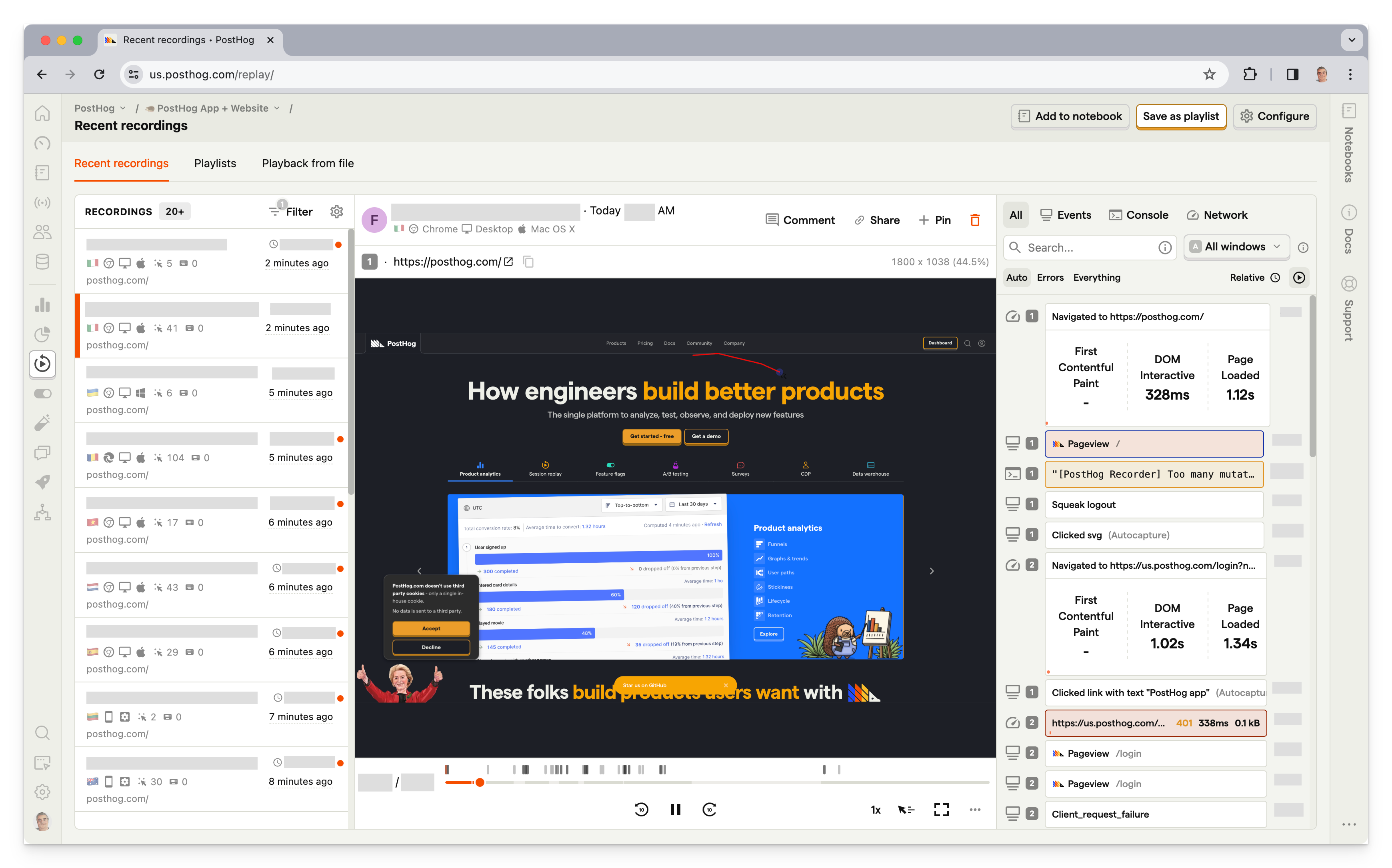
PostHog (that's us 👋) is a developer platform combining product analytics, session replay, user surveys, heatmaps, feature flags, error tracking, and more into one product. This means it's not only an alternative to FullStory, but also tools like LaunchDarkly, Hotjar, and Amplitude.
Typical PostHog users are engineers and product managers at startups and mid-size companies, particularly B2B companies. Customers include Supabase, ElevenLabs, Lovable, and more.
Key features
Product analytics: Funnels, user paths, retention analysis, custom trends, and dynamic user cohorts. Also supports SQL insights for power users.
Session replays: Including event timelines, console logs, network activity, and 90-day data retention.
Surveys: Target surveys by event or person properties. Templates for Net Promoter Score (NPS), product-market fit (PMF) surveys, and more.
A/B tests: Up to 9 test variations, primary and secondary metrics. Automatically calculate test duration, sample size, and statistical significance.
Feature flags: Safely launch features with local evaluation (for faster performance) and JSON payloads.
Error tracking: Monitor exceptions, stack traces, and crashes, all connected directly to session replays, user behavior, and feature flag changes.
How does PostHog compare to FullStory?
PostHog goes beyond the feature set of FullStory. It matches key features like single snippet installation, user segmentation, and privacy options, while also having surveys, A/B testing, error tracking, and feature flags. As a (big) bonus, it's also free, self-serve, and open source.
Getting started takes minutes with PostHog's setup wizard, which walks you through installation step by step.
Main differences between PostHog and FullStory
- PostHog includes feature flags, A/B testing, error tracking, and LLM analytics; FullStory doesn't offer any of these natively.
- PostHog's session replay includes console logs, network monitoring, DOM explorer, and performance metrics; FullStory's replay focuses on frustration signals (rage clicks, dead clicks, error clicks) but lacks developer debugging tools.
- PostHog uses transparent, usage-based pricing with a generous free tier (1M events, 5,000 replays free); FullStory's paid plan pricing requires contacting sales.
- PostHog includes a built-in data warehouse for importing and querying external data from Stripe, Hubspot, Zendesk, and more; FullStory's data export options are more limited.
- PostHog offers SQL access for custom queries; FullStory doesn't support direct SQL querying.
Main similarities between PostHog and FullStory
- Both support event autocapture that starts collecting data immediately after installation.
- Both include product analytics with funnels, user paths, and conversion tracking.
- Both offer session replay and heatmaps for understanding user behavior.
- Both provide user privacy controls and data masking options.
- Both support web and mobile app analytics.
- Both integrate with third-party tools like Segment and Slack.
Why do companies use PostHog?
According to reviews on G2, companies use PostHog because:
It replaces multiple tools: PostHog can replace FullStory (session replay and analytics), LaunchDarkly (feature flags and A/B testing), and Userpilot (feedback and surveys). This simplifies workflows and ensures all product is in one place.
Pricing is transparent and scalable: Reviewers appreciate how PostHog's pricing scales as they grow. There's a generous free tier they can use forever. Companies eligible for PostHog for Startups also get $50k in additional free credits.
They need a complete picture of users: PostHog includes every tool necessary to understand users and improve products. This means creating funnels to track conversion, watching replays to see where users get stuck, testing solutions with A/B tests, and gathering feedback with user surveys.
Bottom line
PostHog provides all the tools of FullStory and more. Being self-serve with a generous free tier makes it an ideal alternative to try out. PostHog is an especially good fit for SaaS companies needing multiple tools to build the best product possible.


Install PostHog with one command
Paste this into your terminal and make AI do all the work.

2. Smartlook
- Founded: 2016
- Most similar to: Heap, FullStory
- Typical users: Engineers, business analysts, product managers
- Typical customers: Enterprise retail and ecommerce websites and apps
What is Smartlook?
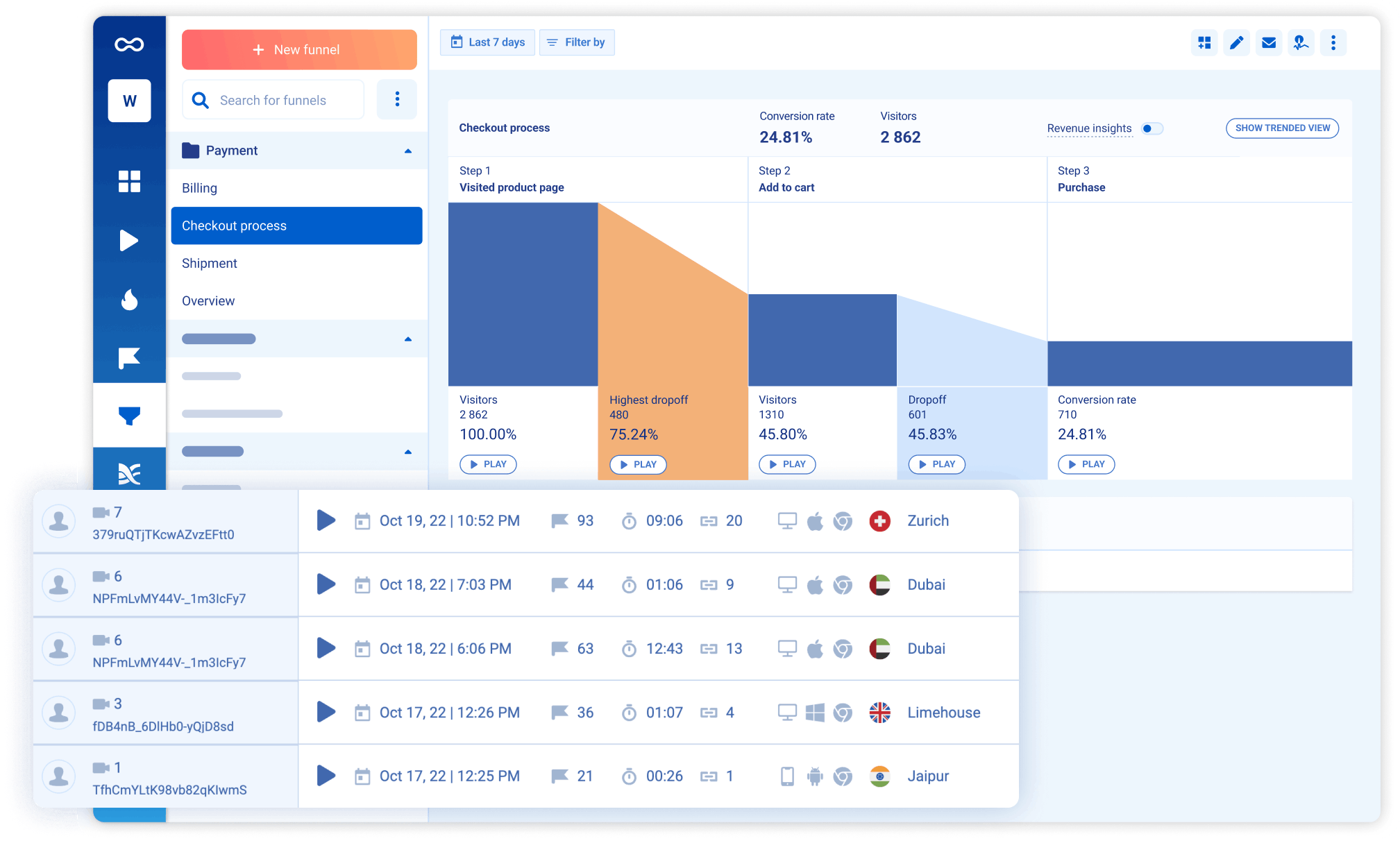
Smartlook is an analytics platform that combines session replays with product analytics, visualizations, and crash reports to generate user insights. It focuses on mobile apps with specific tools like mobile heatmaps, native rendering, and wireframe mode.
Cisco acquired Smartlook in June 2023 to strengthen its AppDynamics and Full-Stack Observability offerings, though Smartlook continues to operate as a standalone product.
Key features
Session recordings: Understand how users are actually using your app and where issues occur.
Event-based analytics: See how often users behave in the ways important to you.
Heatmaps: Figure out the most popular parts of a page users click on and scroll to.
Funnels and paths: See how users move through your app with custom visuals for key flows.
Crash reports: Learn what happens before a crash without complex debugging or reproduction.
How does Smartlook compare to FullStory?
The feature sets of Smartlook and FullStory are nearly identical. The difference is that Smartlook focuses slightly more on product analytics, is self-serve, and adds crash reports.
Main differences between Smartlook and FullStory
- Smartlook specializes in mobile apps with native rendering, wireframe mode, and mobile-specific heatmaps; FullStory supports mobile but is more web-focused.
- Smartlook includes crash reporting tied directly to session replays; FullStory doesn't offer crash or error tracking.
- Smartlook is fully self-serve with transparent pricing starting at $55/month; FullStory's paid plans require contacting sales.
- FullStory offers more advanced frustration signal detection (rage clicks, dead clicks, error clicks); Smartlook's approach is more manual.
- Smartlook was acquired by Cisco in 2023 and is now part of their AppDynamics ecosystem; FullStory remains independent.
Main similarities between Smartlook and FullStory
- Both offer session replay and heatmaps for understanding user behavior.
- Both include product analytics with funnels, user paths, and conversion tracking.
- Both support event autocapture to reduce manual instrumentation.
- Neither offers feature flags or A/B testing natively.
- Both are designed to be accessible to non-technical teams.
- Both are closed-source, cloud-only platforms.
Why do companies use Smartlook?
According to G2 reviewers, Smartlook users benefit from:
The integration between replays and events: Smartlook connects event-based analytics and sessions. This enables users to dive deeper into user behavior than a single tool provides.
Understanding visitor pain points: The analytics and visualizations make it easy to understand where users are running into trouble. Reviews use this to improve the user experience and conversion in these areas.
Real user monitoring: Smartlook shows how real users are using your app and monitors the quality of their experiences. Reviewers use it to figure out what areas are confusing or used improperly.
Bottom line
Smartlook and FullStory have nearly the same focuses and features, with Smartlook offering a stronger mobile focus and transparent pricing. This makes it a great alternative for ecommerce and retail companies with native apps.
3. Amplitude
- Founded: 2012
- Most similar to: PostHog, LogRocket
- Typical users: Product managers, data analysts, marketing teams
- Typical customers: Mid-size and large enterprises
What is Amplitude?
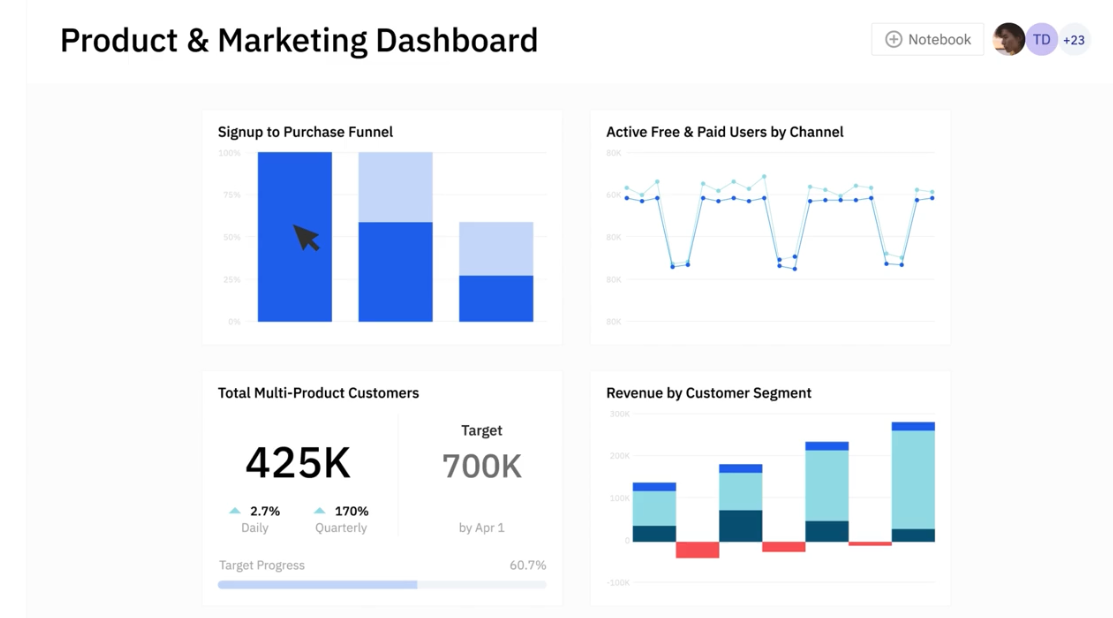
Amplitude is one of the original product analytics tools. Many large enterprise customers, like Ford, NBCUniversal, and Walmart rely on it. In recent years, they've also added session replay, A/B testing, and a customer data platform to their offering.
Key features
Product analytics: Funnel and retention analysis, user paths, behavioral cohorts, custom dashboards, and more.
A/B testing: Test new features on specific targets and analyze with primary, secondary, and counter metrics.
Customer data platform: Combine analytics data with third-party tools for data governance, identity resolution, and data federation.
AI insight builder: Generate insights based on natural language requests, like "What is my purchase conversion rate?"
Session replay: Watch real user sessions with mobile support (iOS, Android).
How does Amplitude compare to FullStory?
Amplitude is analytics-first while FullStory is replay-first. Amplitude offers deeper analytics, A/B testing, and warehouse-native queries, but its autocapture is less comprehensive than FullStory's and its session replay is a newer addition.
Why do companies use Amplitude?
According to G2 reviews, Amplitude users appreciate three key aspects:
Simple to use: Amplitude makes it easy for non-technical users to get insights about their product and make improvements. Amplitude is built for users like product managers and marketers, making it a popular choice for them.
Built-in A/B testing: Unlike FullStory, Amplitude offers integrated experimentation features. This enables companies to run experiments on existing cohorts, and then analyze the data in a single place.
Become data-driven: Amplitude users appreciate it helps them become data-driven. It becomes easy to add data, visualize it, and make decisions. It makes data accessible to them.
Bottom line
Amplitude is a popular choice for product analytics with strong experimentation features, but lacks the depth of session replay and frustration detection that makes FullStory powerful. If you value A/B testing and deep analytics over replay-first UX insights, it can be a good choice.
4. Heap
- Founded: 2013
- Most similar to: FullStory, PostHog
- Typical users: Product and marketing teams
- Typical customers: B2C SaaS and ecommerce companies wanting to monitor and improve user experience.
What is Heap?
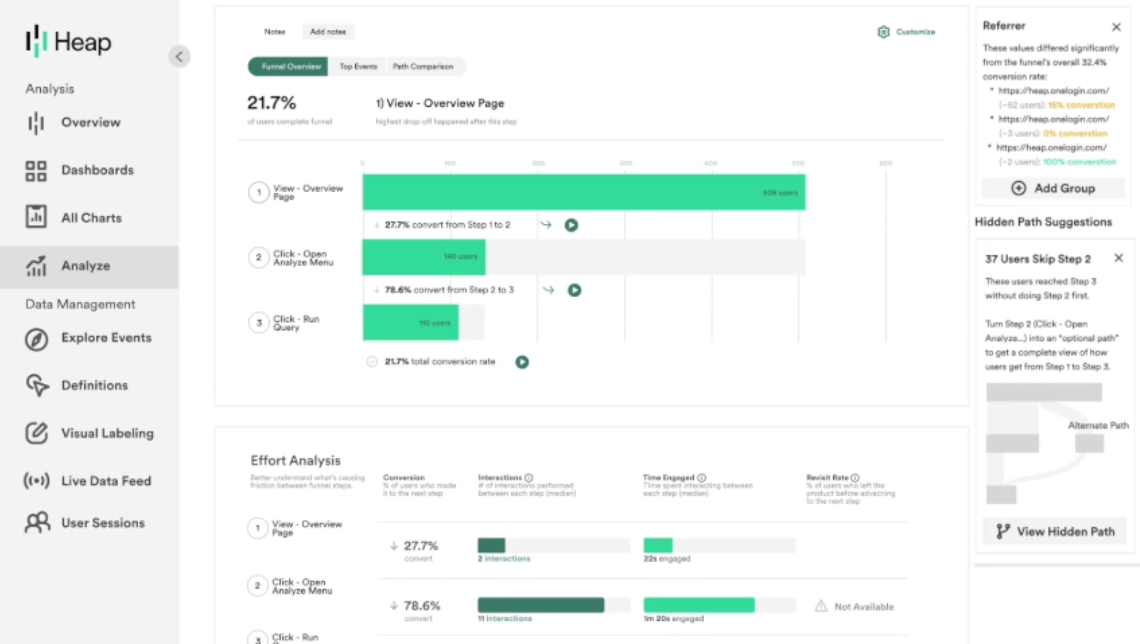
Heap describes itself as a digital insights platform. This means Heap offers both product analytics and session replay, and supports marketing use cases with multi-touch attribution.
Contentsquare, a marketing and ecommerce analytics firm, acquired Heap in September 2023 and has integrated the two products.
Key features
Event autocapture: Frees product teams from relying on engineers to instrument all events. Heap offers a visual editor for enables teams to tag on-page events for analysis.
Session replay: Augment Heap's analytics features with qualitative insights by replaying their session (although this lacks the debugging tools typical of most replay tools).
Heatmaps: See where users click, what point they scroll to, and the areas that get the most attention.
Analysis suggestions: Their advanced data science capabilities discover hidden interactions, friction points, and paths.
Managed ETL: Connect to data warehouses, so you can combine your analytics with other sources and get a fuller picture of the entire user journey.
How does Heap compare to FullStory?
Heap and FullStory both focus on user experience data and have many of the same features to do it. Autocapture is a main selling point for both.
FullStory leans more toward session replay and frustration signals, while Heap is stronger on the analytics side with its visual event editor and retroactive event definition.
Main differences between Heap and FullStory
- Heap has a visual event editor for non-technical users to tag and define events retroactively without code; FullStory doesn't offer an equivalent labeling tool.
- FullStory's core strength is session replay with frustration signals (rage clicks, dead clicks, error clicks); Heap leads with product analytics and retroactive event definition.
- Heap offers managed ETL for exporting data to warehouses like Snowflake and BigQuery; FullStory's data export options are more limited.
- FullStory is more commonly used by customer success and support teams; Heap is primarily used by product managers.
Main similarities between Heap and FullStory
- Both support event autocapture that starts collecting data immediately after installation.
- Both offer session replay and heatmaps for understanding user behavior.
- Both include product analytics with funnels, user paths, and conversion tracking.
- Both are designed to be accessible to non-technical teams.
- Neither offers feature flags or A/B testing natively.
- Both are closed-source, cloud-only platforms.
Why do companies use Heap?
According to G2 reviews, companies enjoy these three areas of Heap:
Autocapture: Non-technical users love how easy autocapture makes tracking on their site. Along with the element data included, this provides a massive amount of useful analytics data.
Simple setup: Heap does not take a big technical effort to set up. Users can add a single script, begin collecting data, and easily visualize that data through user paths, funnels, and session replays.
Streamlining analysis: By having analytics and session replay data in one place, Heap makes it easy to understand the usage of their app or site. This replaces interviews or user testing and makes the development cycle faster.
Bottom line
Heap and FullStory have nearly the same features. Along with Heap's free trial, this makes them a solid alternative for experience analytics and insights. Although its acquisition by ContentSquare has its future up in the air.
5. Glassbox
- Founded: 2010
- Most similar to: FullStory, PostHog
- Typical users: Business analysts, product support, marketers
- Typical customers: Enterprise B2C companies, retail, and financial services
What is Glassbox?
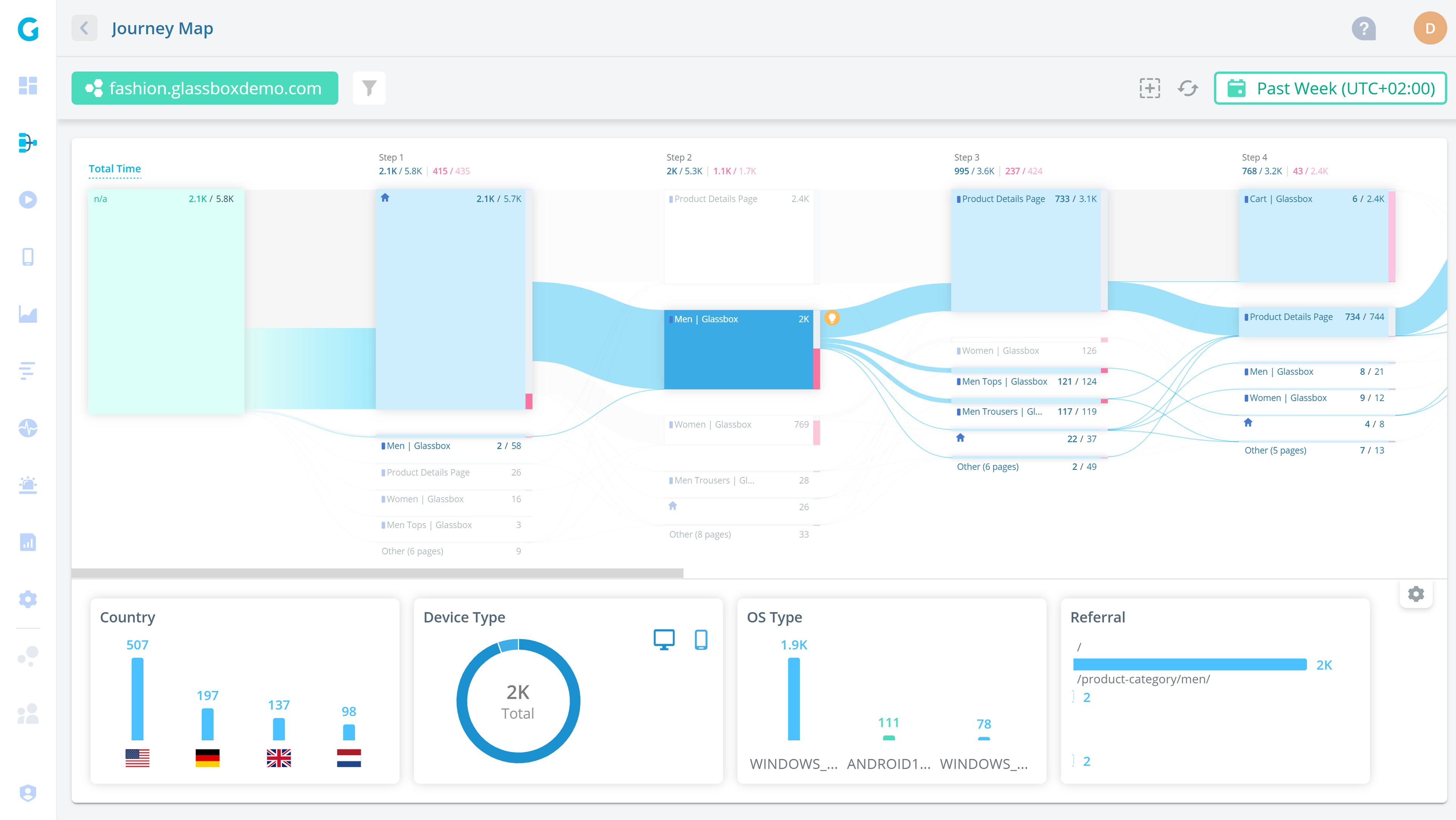
Glassbox is a session replay and analytics platform with a particular focus on mobile apps and ecommerce use cases. Customers include Danone, Air Canada, and UK retailer Sainsbury's.
Glassbox predominantly provides "digital experience intelligence" to business analysts and support teams in enterprise B2C companies.
Key features
Session replay: Watch and analyze real user sessions on web and mobile apps.
Product analytics: Understand user paths and struggle points.
Performance analytics: Track app performance and its impact on conversion rates.
Click, scroll, and heatmaps: Understand where users interact with your app.
User feedback: Gather satisfaction and user feedback on the app experience.
How does Glassbox compare to FullStory?
Glassbox and FullStory share many of the same features, but Glassbox is not self-serve and it's unclear how easy implementation is. Glassbox has a stronger mobile focus and includes performance analytics that FullStory lacks.
Main differences between Glassbox and FullStory
- Glassbox includes performance analytics that track app speed and its impact on conversion; FullStory doesn't offer native performance monitoring.
- Glassbox has proprietary struggle detection and "struggle scores" for identifying user friction; FullStory uses frustration signals like rage clicks and dead clicks.
- Both now offer user feedback collection – Glassbox has had it longer, while FullStory launched Guides & Surveys in February 2026.
- FullStory offers a free plan (FullstoryFree) and a 14-day trial; Glassbox is sales-driven with no public pricing or free plan.
- Glassbox has a stronger focus on native mobile app analytics with dedicated mobile session replay; FullStory supports mobile but requires an add-on for mobile apps.
Main similarities between Glassbox and FullStory
- Both offer session replay and heatmaps for understanding user behavior.
- Both include product analytics with funnels, user paths, and conversion tracking.
- Both support event autocapture without manual instrumentation.
- Neither offers feature flags or A/B testing natively.
- Both are closed-source, cloud-only platforms.
Why do companies use Glassbox?
According to G2 reviews, customers use Glassbox for:
Session replay and error analysis: Glassbox is best known for its session replay features, so this is the most popular use case. Customers use Glassbox to analyze user journeys and identify app-breaking bugs.
Heatmap and funnel analysis: Users like the heatmaps feature, which enables them to see user preferences on key pages. They combine this with paths and funnels to see the entire journey.
Fixing low conversion and abandonment: Glassbox is popular among online retailers, who use it to solve issues with conversion and basket abandonment. Their struggle scores are a popular feature for figuring this out.
Bottom line
Glassbox has nearly all the features of FullStory and more, along with a deeper focus on mobile. If you are willing to go through the sales process, it is another great alternative to try out, especially for B2C, ecommerce, and retail companies.
6. LogRocket
- Founded: 2016
- Similar to: PostHog, Smartlook
- Typical users: Product managers, engineers, support teams
- Typical customers: B2B SaaS, B2C retail companies.
What is LogRocket?
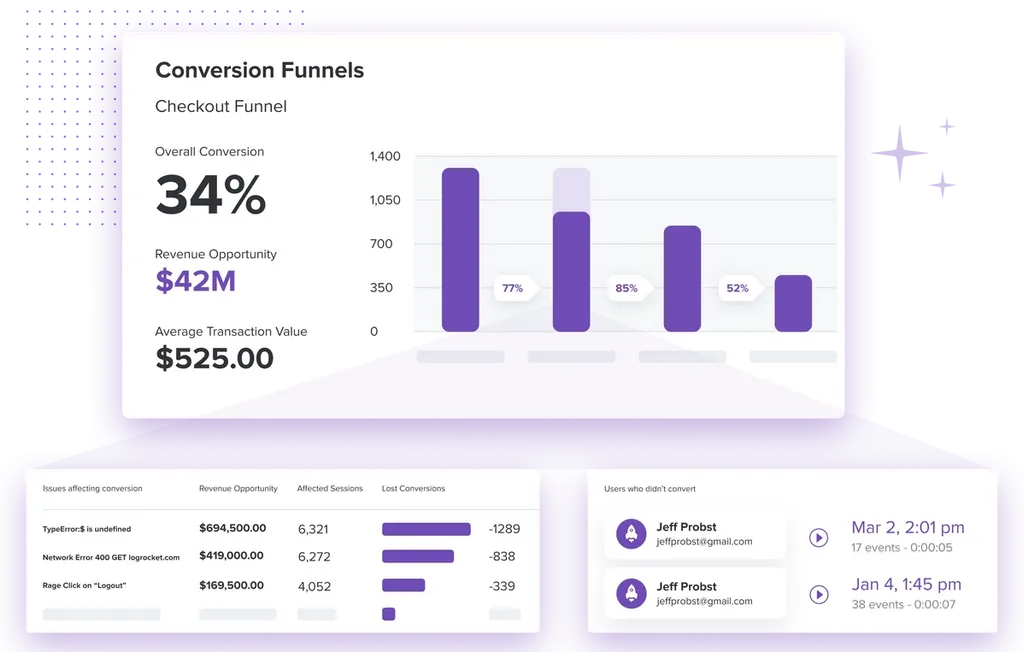
LogRocket is a product experience platform with product analytics, error tracking, session replay, and performance monitoring. It focuses on helping product managers, engineers, and support teams identify and fix issues.
Key features
Session replay: Understand exactly what users are doing on your site. See the screens they visit, places they click, as well as console and network logs, errors, and performance data.
Error tracking: Identify and triage the most impactful issues with JavaScript and network errors as well as stack traces.
Product analytics: Capture usage data and visualize it with conversion funnels, path analysis, and retention charts.
Heatmaps: See what users are clicking on, where they are spending their time, and how far they scroll.
Performance monitoring: Monitor frontend performance such as web vitals, CPU and memory usage, and network speed.
How does LogRocket compare to FullStory?
LogRocket matches many of FullStory's features while having a greater focus on error and performance tracking.
Main differences between LogRocket and FullStory
- LogRocket includes JavaScript error tracking with stack traces; FullStory has no error tracking.
- LogRocket monitors web vitals, CPU, memory, and network performance; FullStory doesn't offer performance monitoring.
- FullStory has more mature frustration signal detection (rage clicks, dead clicks, error clicks); LogRocket focuses more on debugging and technical issues.
- LogRocket is built for debugging and issue resolution; FullStory focuses on behavioral analytics and UX optimization.
- LogRocket is self-serve with transparent pricing; FullStory's paid plans require contacting sales.
Main similarities between LogRocket and FullStory
- Both offer session replay for understanding user behavior in detail.
- Both include product analytics with funnels, user paths, and retention charts.
- Both provide heatmaps for visualizing clicks and scroll depth.
- Neither offers feature flags or A/B testing natively.
- Both integrate with popular development and collaboration tools.
- Both are closed-source, cloud-only platforms.
Why do companies use LogRocket?
The reviewers of G2 use LogRocket for these reasons:
Identifying problems: LogRocket's combination of error tracking, performance monitoring, and session replay makes it uniquely powerful at finding bugs and issues. Unlike other tools, it uncovers both user and software issues.
Improves user experience: LogRocket seems to succeed at their goal of helping users fix issues. Reviewers find it provides all the tools to improve their user experience.
High usability: LogRocket provides a lot of functionality out of the box. It captures the details users need, provides useful visualizations, and automatically triages some issues.
Bottom line
Like many of the alternatives, LogRocket provides all the features of FullStory and more. For team teams looking to identify and fix the issues with their site or product, it makes a great choice.
7. Pendo
- Founded: 2013
- Most similar to: PostHog, Hotjar
- Typical users: Product managers and customer success teams
- Typical customers: Small and mid-market B2C apps

What is Pendo?
Pendo describes itself as a product experience platform. In addition to product analytics, it offers session replay, in-app guides, user feedback, and product validation tools.
Key features
Product analytics: Funnels, trends, and retention analysis with event autocapture.
In-app guides: Deliver personalized guidance to customers, directly inside your app.
User feedback: Capture and analyze customer feedback at scale.
Product validation and roadmaps: Plan your product improvements and roadmap using data from Pendo.
How does Pendo compare to FullStory?
Although Pendo shares similarities with FullStory, it focuses more on qualitative feedback, in-app guides, and product planning. It lacks the autocapture that makes FullStory powerful.
Main differences between Pendo and FullStory
- FullStory now offers Guides & Surveys for in-app messaging and targeted surveys, though Pendo's in-app guides are more mature with tooltips, onboarding flows, and feature announcements.
- Pendo has built-in product validation and roadmap tools for aligning teams on priorities; FullStory focuses purely on analytics and replay.
- FullStory's session replay is more mature with frustration signal detection; Pendo's replay is functional but secondary to its product experience tools.
Main similarities between Pendo and FullStory
- Both support a form of event autocapture to reduce manual instrumentation.
- Both offer session replay for watching real user sessions.
- Both include product analytics with funnels, trends, and user paths.
- Neither offers feature flags, A/B testing, or experiments natively.
- Both are primarily designed to be accessible to non-technical product teams.
- Both are closed-source, cloud-only platforms.
Why do companies use Pendo?
According to G2 reviews, customers use Pendo for:
Customer support and feedback: Users value Pendo as a useful tool for customer support and feedback collection. They use Pendo's feedback features to gather qualitative data and feed that into Pendo's validation and roadmap features.
Improving onboarding: Combining Pendo's in-app guides and analytics features makes it easy for non-technical users to experiment with new onboarding flows, improving user adoption.
Product planning: Customers to use Pendo's data tools, product validation, and roadmap features to align internal teams and stakeholders on product development.
Bottom line
Pendo offers many similar features to FullStory, but the lack of autocapture is a big downside. Pendo is likely only a good alternative if you want their feedback, product tour, and product planning features.
Which FullStory alternative should you choose?
- Want an all-in-one developer platform with analytics, session replay, error tracking, feature flags, experiments, surveys, and more? Go with PostHog.
- Need session replay with mobile-first analytics and crash reports? Smartlook specializes here.
- Looking for deep product analytics with built-in A/B testing and a CDP? Amplitude skews enterprise.
- Want comprehensive autocapture with a visual event editor? Heap gets you started fast.
- Mobile-first with native app heatmaps, performance analytics, and struggle scores? Glassbox is built for that.
- Frontend debugging with error tracking and performance monitoring? LogRocket connects it all.
- Need in-app guides, product tours, and roadmap tools alongside analytics? Pendo combines them.
Is PostHog right for you?
Here's the (short) sales pitch.
We're biased, obviously, but we think PostHog is the perfect FullStory replacement if:
- You value transparency (we're open source and open core)
- You want tools to ship, track, and analyze new features like A/B testing, feature flags, and surveys.
- You want to try before you buy (we're self-serve with a generous free tier)
It's completely free to get started – no credit card required. Our setup wizard handles configuration in minutes, or you can check out our docs to do it yourself.
Install PostHog with one command
Paste this into your terminal and make AI do all the work.
Frequently asked questions
What is FullStory used for?
FullStory is a digital experience intelligence platform that combines session replay, product analytics, heatmaps, and frustration signal detection (rage clicks, dead clicks, error clicks). Product, UX, and customer success teams use it to understand how users interact with their websites and apps, diagnose user problems, and improve conversion rates.
Why look for FullStory alternatives?
Common reasons include: needing features FullStory doesn't offer (like feature flags, A/B testing, or error tracking); wanting more transparent, self-serve pricing instead of sales-driven contracts; preferring a more developer-friendly or open-source platform; or wanting more developer debugging tools in session replay (like console logs and network monitoring).
What's the best FullStory alternative overall?
For most teams, PostHog is the best alternative. It matches FullStory's session replay and analytics while adding feature flags, A/B testing, error tracking, LLM analytics, and a built-in data warehouse – all with transparent pricing and a generous free tier.
Which FullStory alternatives support autocapture?
PostHog, Heap, Smartlook, Glassbox, and Pendo all support some form of autocapture. PostHog and Heap are the closest to FullStory's approach – both start recording interactions immediately after installation. Smartlook's autocapture is also comprehensive. Pendo's autocapture is more limited, covering page loads and feature clicks but not the full range of interactions FullStory captures.
Which FullStory alternatives are open source?
PostHog is the only open-source FullStory alternative on this list; its code is publicly available on GitHub. All other tools listed – Smartlook, Amplitude, Heap, Glassbox, LogRocket, and Pendo – are closed-source. See our guide to the best open-source analytics tools for more options.
Which FullStory alternative has the best free tier?
PostHog offers the most generous free tier: 1 million events, 5,000 session replays, and 1 million feature flag requests per month – with no credit card required. FullStory's free plan (FullstoryFree) includes 30,000 sessions with 12 months of retention but excludes dashboards, mobile apps, and StoryAI. Smartlook offers a free plan with 3,000 monthly sessions. Amplitude offers 10K monthly tracked users free.
Does FullStory have feature flags or A/B testing?
No. FullStory doesn't offer native feature flags or experimentation. You'd need a separate tool like LaunchDarkly, Optimizely, or PostHog. PostHog includes both feature flags and A/B testing natively, tightly integrated with analytics so you can measure experiment impact on funnels, retention, and revenue.
Does FullStory have error tracking?
No. FullStory doesn't offer error tracking or crash monitoring. If you need to monitor exceptions alongside your session replays, you'd need a separate tool like Sentry or Bugsnag. PostHog includes native error tracking that connects exceptions and stack traces directly to session replays, user behavior, and feature flag changes. LogRocket also includes error tracking and performance monitoring.
Is FullStory free?
FullStory offers a free plan called FullstoryFree that includes 30,000 sessions per month, 12 months of data retention, and up to 10 users. However, it excludes advanced features like dashboards, configurable form privacy, mobile apps, and StoryAI. FullStory also offers a 14-day free trial of its Business plan. Paid plans require contacting their sales team for pricing.
Can I migrate from FullStory to PostHog?
Yes – though there are some caveats. You can export historical event data from FullStory and import it into PostHog using the historical migrations guide. Session replay recordings can't be migrated since they're stored in FullStory's proprietary format. The simplest approach is to install PostHog's snippet alongside FullStory, run both in parallel, and transition fully once you're confident in the setup.
Does PostHog offer EU hosting?
Yes. PostHog offers EU-hosted cloud with data stored exclusively in the EU. PostHog is also SOC 2 certified, GDPR-ready, and HIPAA-ready.
Which alternative is best for mobile app analytics?
Glassbox and Smartlook both specialize in mobile app analytics with native mobile session replay, mobile heatmaps, and crash reporting. PostHog also supports mobile analytics with SDKs for iOS, Android, React Native, and Flutter – and is one of the few tools that includes mobile session replay for free (2,500 recordings/month).
FullStory's mobile app analytics require a paid add-on, and most other tools either charge extra for mobile replay or don't offer it at all.
Which alternative is best for session replay?
PostHog and LogRocket both excel at session replay with developer debugging tools. PostHog's strength is connecting replays to the broader product context – you can jump from a funnel drop-off directly into a relevant replay, or see which feature flag variant a user was on. LogRocket adds performance monitoring and is particularly strong for debugging frontend issues with detailed network and console data.
FullStory itself remains strong for replay with frustration signal detection, though it lacks the developer tools PostHog and LogRocket offer.
What happened to Heap after the Contentsquare acquisition?
Contentsquare completed its acquisition of Heap in December 2023. Heap's product analytics features have been integrated into Contentsquare's broader experience intelligence platform, alongside Hotjar. Heap continues to operate as a product, but its roadmap is now shaped by Contentsquare's enterprise and ecommerce focus.
What are the best product analytics tools in 2026?
The top product analytics tools in 2026 include:
- PostHog – Best all-in-one platform combining product analytics with web analytics, session replay, A/B testing, feature flags, and more
- Mixpanel – Best for self-serve product teams wanting fast, flexible analytics
- Amplitude – Best for enterprises wanting warehouse-native analytics and a built-in CDP
- Heap – Best for teams wanting comprehensive autocapture with minimal engineering effort
- Pendo – Best for product managers who also need in-app guides and user onboarding
- Google Analytics – Best for marketing teams already invested in the Google ecosystem
For detailed comparisons, see our guides to Mixpanel alternatives, Amplitude alternatives, and Heap alternatives.

Subscribe to our newsletter
Product for Engineers
Read by 100,000+ founders and builders
We'll share your email with Substack
PostHog is an all-in-one developer platform for building successful products. We provide product analytics, web analytics, session replay, error tracking, feature flags, experiments, surveys, LLM analytics, logs, workflows, endpoints, data warehouse, CDP, and an AI product assistant to help debug your code, ship features faster, and keep all your usage and customer data in one stack.